
As organisations begin planning for next year, it is natural to focus on targets, budgets and new priorities. But plans are delivered by people, through everyday decisions, conversations and behaviours. Planning next year with your team means asking not only what the organisation wants to achieve, but what people will need in order to make it happen.
That question matters as AI and other changes reshape work. The technology may be new, but the challenge of adapting together is familiar. Teams need to understand what is changing, communicate clearly and keep learning as they go.
Planning next year with your team means looking beyond results

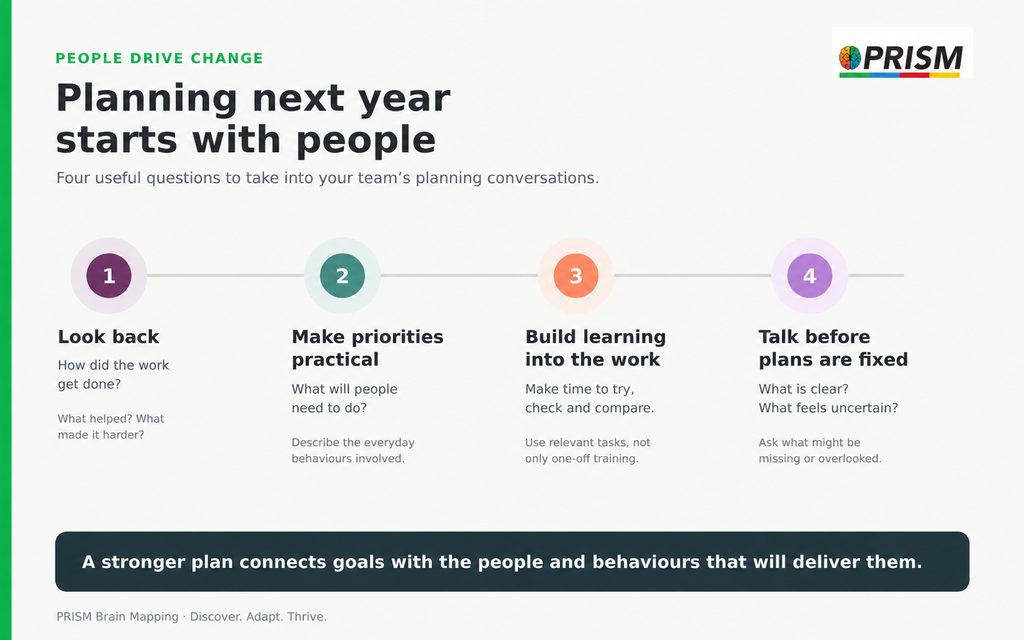
A year-end review often starts with outcomes. Which targets were met? Which projects were completed? Those questions matter, but they do not tell the whole story.
It is also useful to ask how the work got done. When did people communicate well? What helped decisions move forward? Where did work become harder than it needed to be? Which strengths did the team rely on, and were any perspectives missing?
These questions can help coaches and people professionals look beneath the result. A target may have been achieved, but at the cost of repeated pressure or unclear responsibilities. Another may have been missed because people lacked information, time or the opportunity to coordinate their work.
Understanding those patterns gives next year’s plan a stronger starting point. It can help distinguish between a skills gap, a process problem and a conversation that has not yet happened.
Turn next year’s priorities into everyday behaviour
A priority such as “use AI more effectively” sounds clear, but it can mean different things in different roles. What tasks should AI support? What will still require human judgement? How will people check an output before using it?
Skills England’s 2026 Annual Skills Report identifies communication, critical thinking and analytical skills as important capabilities for workers using AI. That means workforce planning needs to consider both the technology and the behaviours people will use around it.
Henley Business School’s 2026 survey of 2,900 full-time UK workers found that 58% were optimistic about AI at work, while 61% felt overwhelmed by its pace. Optimism and uncertainty can exist at the same time. Providing access to a tool does not necessarily mean people feel ready to use it.
For each priority, try describing what people will need to do in practice. They may need to question an answer, explain their reasoning, share learning with colleagues or raise a concern when something does not look right. Clearer behaviours make it easier to identify the support and development required.
Make learning part of the plan
If people are expected to adapt, learning needs to be built into the work rather than left as an optional extra.
The Skills England supported Skills for AI research recommends practical, task-based training that is accessible, flexible and connected to people’s roles. The evidence also cautions against treating AI development as a one-off course or tool demonstration.
In practice, that could mean setting aside time to try a tool on a relevant task, giving people clear guidance on what to check and creating opportunities to compare approaches. It also means asking whether the training has helped people do the work more confidently and appropriately.
CIPD guidance similarly recommends that organisations assess how tools affect work and roles, invest in workforce skills, and protect time for judgement, coaching and relationship-based work. This makes development part of how work is designed, not an activity separate from it.
Have the conversations before the plan is fixed
People will not always respond to change in the same way. Some may want to explore possibilities. Others may want to understand the detail, the practical impact or how the change affects colleagues.
Those differences are not a reason to label people as resistant or enthusiastic. They are a reason to ask better questions. What is clear? What still feels uncertain? What would help you take part? What might we be overlooking?
For leaders, coaches and L&D professionals, these conversations can surface concerns early and help people connect the direction of travel with their own work. They can also help a team notice where communication needs to change, or where a decision needs more discussion before it can be put into practice.
How behavioural insight can help
Behavioural insight can support these conversations by helping people reflect on how they tend to communicate, respond and adapt at work. It can also help teams recognise that colleagues may bring different strengths and different questions to the same situation.
PRISM provides a way to explore behavioural preferences and how behaviour may adapt to the demands of a role or situation. Used with discussion and reflection, it can help individuals build self-awareness and help teams understand one another more clearly. It does not replace AI training or develop analytical skills by itself. Its value is in supporting the human conversations that help people work together as change happens.
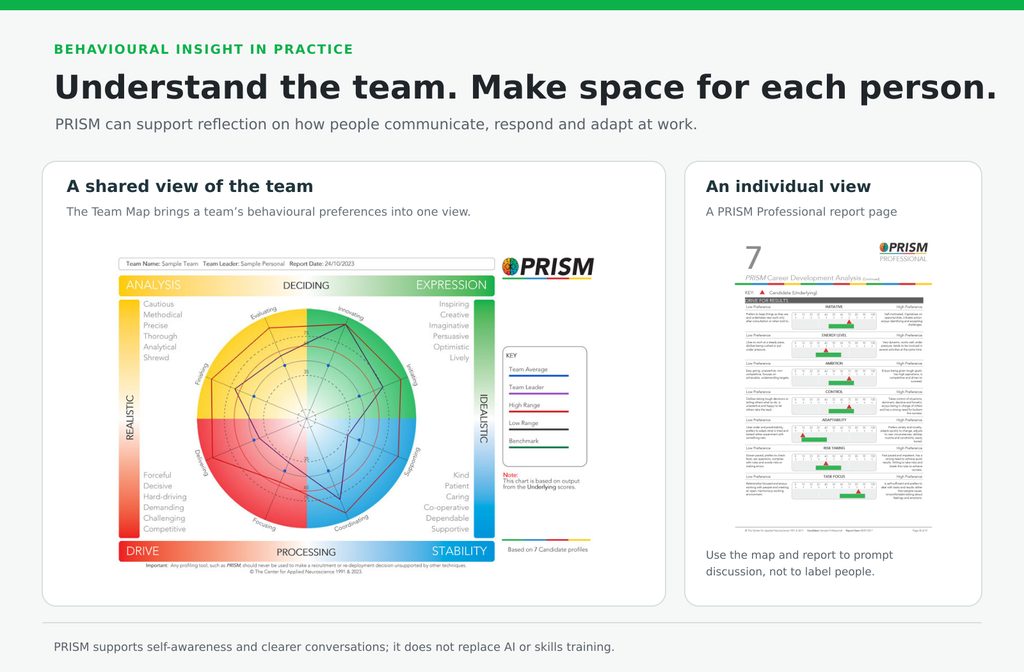
You can read more about PRISM Team Maps and PRISM Professional. For coaches, HR and L&D professionals interested in using PRISM with clients or teams, details are available on PRISM Practitioner Accreditation.
Start with the people who will make it happen
Planning next year with your team is not simply about setting ambitious goals. It is about understanding the behaviours, skills and conversations that will help people deliver them.
Before the plan is final, ask what the year has taught you about how people work together. Then build the answers into the priorities, learning and support for the year ahead.
What is one conversation your team should have before next year’s plan is set?
References and further reading
